
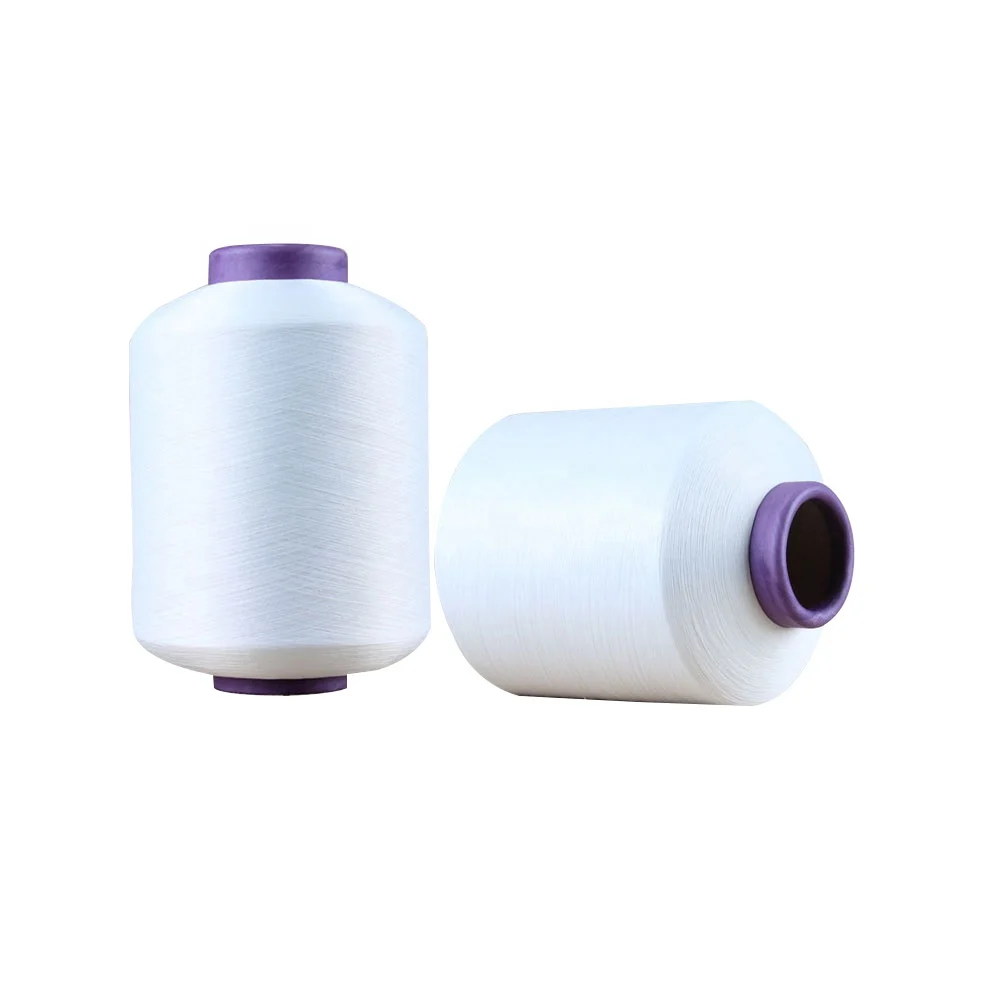
Air-covered yarn (ACY) uses a jet of compressed air to interlace a filament cover with a stretched elastane core. Machine-covered yarn uses a spindle to wind one or two cover yarns in a continuous spiral around the core. Both constructions put an elastic core and a textile cover on the same package. The way they bring those components together changes the surface of the yarn and gives the fabric developer different options for coverage, hand, and feeding.
For a sock or seamless garment, the first questions are where the yarn will sit in the fabric, how much the fabric needs to stretch, and how it should look and feel at that extension. Those answers give you a basis for choosing between ACY, single-covered yarn, and double-covered yarn and for comparing samples on the production machine.
How air and mechanical covering work
Air-covered yarn
During air covering, the stretched elastane and the cover filament pass through a jet together. The air stream entangles the filaments around the core at points along the yarn, with more open lengths in between. These interlacing points hold the components together as they unwind and feed. A study of air interlacing found that a continuous air jet can create both tangled and open sections along a yarn. Inspect a sample both relaxed and gently extended to see whether the core or the more open sections become visible at the extension your fabric will experience.
Single-covered and double-covered yarn
In mechanical covering, a rotating package winds the cover in successive turns around the elastane. Single-covered yarn (SCY) has one helical wrap. Double-covered yarn (DCY) has two layers, commonly wound in opposite directions. The second layer can increase coverage and help balance the turning tendency of the first wrap. Its contribution to bulk and hand depends on the size and type of each cover yarn and the number of turns.
Wrap density is one variable you can compare on a technical sheet or discuss with your supplier. A covered yarn study examined how core draft and winding conditions affect the spiral angle of a spandex yarn with a viscose cover. Core draft describes how far the elastane is stretched as it is covered. In a commercial sample, core draft, turns per unit length, and cover count can affect how much of the core you see as the finished yarn extends.
Where each construction is worth sampling
Socks and hosiery
Begin with the part of the sock the yarn will serve. A body yarn has to form consistent loops and deliver the intended hand. A yarn in a cuff can have a different job, such as helping the cuff return to size after it is pulled over the heel. For an ACY body trial, check that the interlacing feeds evenly and that the core stays as discreet as the design requires. Include a mechanically covered option when appearance over the calf or coverage in a stretched cuff is critical. Check the finished sock on a form at the intended circumference and measure the cuff again after removal and relaxation.
Seamless underwear and stretch knits
A single seamless garment can combine an opaque panel, an open mesh zone, and a ribbed edge. A yarn can look even in the opaque panel and show through in the more open zone. Knit a trial containing both structures, with the covered yarn fed in its intended position. For plated structures, check which yarn shows on the outside and against the skin. Look at the change between zones as well as each zone on its own, especially after the garment has relaxed or gone through its intended care cycle.
Woven stretch fabrics and elastic tapes
For woven fabrics and tapes, specify whether the elastic yarn runs in the warp, the weft, or both. A weft stretch construction and a lengthwise elastic tape load the yarn in different directions during use. On an air-jet loom, test insertion with the actual yarn and package. A Ghent University weaving study evaluated elastane yarn constructions through loom trials and measured yarn and fabric properties. For tape, include width stability and edge appearance in the trial, both off the loom and after finishing.
What to confirm on the yarn specification
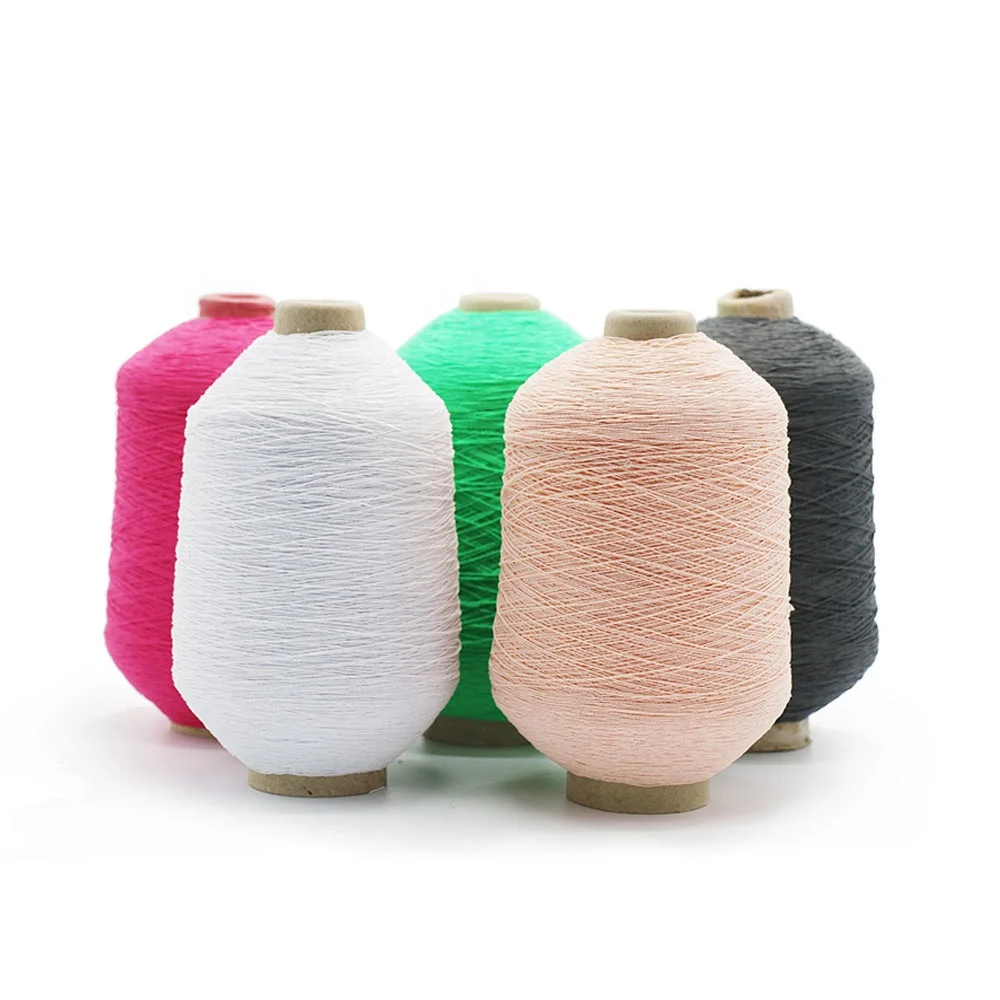
Our covered yarn product page lists air-covered and machine-covered constructions, including polyester-covered and double-covered options, and identifies spandex in the product range. Listed colors include raw white, black, and dope-dyed colors. The product page also lists stockings, garment fabrics, elastic woven tapes, and seamless underwear among the applications. Ask for the exact construction and component counts for the sample you want to run, since the catalog groups several constructions on the same page.
- Identify the core and cover separately. Request the fiber and nominal count for each component, plus the count of the finished yarn and the units used. On a double-covered sample, identify the inner and outer covers separately.
- Specify the covering method on the sample request. For a mechanical wrap, ask for the direction and turns per unit length if those are available. For ACY, ask how the interlacing is specified and checked from lot to lot.
- Confirm shade and package details. A cover shade close to the ground yarn can help when the cover shows on the face. If you intend to dye the fabric, agree on a sample for the actual dye route. Confirm the package form and winding requirements for your feeder or creel.
How to compare two covered yarns on the same fabric
Use the current fabric or an approved sample as a control. Start with the same ground yarn, stitch or weave structure, and finishing route. Record how the elastic yarn is fed, including any change to its tension or feed rate. If a candidate needs a setting change to run well, keep a record of that setting with the sample. Two swatches can feel similar in the hand and behave differently when one requires a different feed to reach the same finished dimensions.
Compare the samples after the same relaxation period. Extend them to a defined load or length, then measure how much extension remains after release and the agreed recovery time. For low-power knits within its scope, ASTM D2594/D2594M describes measuring stretch under load and fabric growth after extension. Agree on a suitable test with your lab for support fabrics, woven materials, or narrow elastics. If the product is meant to be washed, repeat the dimensional and appearance checks after the specified care cycle.
Review the trial in the same order the product is made and used. During production, note feed interruptions, visible yarn separation, or irregular loops. At the finished stage, compare surface, shade, and dimensions in the relaxed and extended states. Keep the approved swatch, its yarn lot, and the machine and finishing settings together. That record helps distinguish a new yarn variation from a process change when a subsequent lot runs differently.
Request samples for your knitting or weaving trial
Tell us whether the covered yarn is for a sock body, a cuff, a seamless panel, or a woven elastic. Include the existing yarn specification if you have one, the machine or feeder type, the target stretch, and a photo or swatch showing the coverage and hand you want. Send us your sample brief so we can identify a construction and package for your trial.
Air-Covered and Machine-Covered Yarn FAQ
Are air-covered yarn and air-textured yarn the same?
Air covering joins a cover filament to a stretched elastic core at interlacing points. Air texturing uses turbulent air to develop texture and bulk in a filament yarn. An air-textured filament may serve as a cover component. Ask for the full yarn construction when the specification only says “air yarn.”
Is double-covered yarn always stretchier than single-covered yarn?
The core, wrap geometry, and way the yarn is fed into the fabric all influence extension and recovery. The second wrap adds another layer of coverage. Compare the two candidates at the same working load and evaluate the finished fabric at the extension it will see in use.
Can I substitute ACY for SCY in an existing sock?
Trial the substitution in the intended part of the sock and record the feeder settings, finished dimensions, appearance on a form, and recovery after extension. A match in nominal count is a useful starting point. The two constructions can feed and cover differently, so use the finished sock to approve the substitution.